
Effectuation
Effectuation - Events
Events
Learn about upcoming events with Professor Saras Sarasvathy.
Featured Event

30 October 2026, Charlottesville, Virginia
The Batten Institute for Entrepreneurship, Innovation and Technology is hosting an exclusive gathering for entrepreneurship educators at the UVA Darden School of Business. Join us for a unique opportunity to explore innovative approaches to teaching entrepreneurship with Professor Saras Sarasvathy, an expert on the cognitive basis for high-performance entrepreneurship and the creator of effectuation.
The day will include two case sessions and two experiential sessions, described in detail below. All sessions will incorporate the Causal, Adaptive, Visionary, and Effectual (CAVE) framework for organizing the content in your entrepreneurship curriculum.
-
Agenda
From the Plunge Decision to Soaring: Teaching Effectual Entrepreneurship through Case Studies and Experiential Exercises
9:30 a.m. - 10 a.m. Breakfast (outside Classroom 170)
10 a.m. - 11:30 a.m. The Plunge Decision: The CreditSource Case (Classroom 170)
Students—even when genuinely excited about becoming entrepreneurs—often stall when it comes to taking the plunge into starting a new venture. Entrepreneurship programs that focus only on idea generation and pitch competitions miss the opportunity to address what it takes to move from idea to action in building actual ventures. The CreditSource case tells the true story of Doug Lebda, a Darden student inspired by an entrepreneurship course to start his own business, CreditSource USA. It takes a realistic approach to the plunge decision, helping educators address a variety of issues that keep students dithering at the edge of the cliff. The key is helping students realize that the cliff is an illusion and that they can move forward by doing what is immediately doable.11:45 a.m. - 1 p.m. Exercises in Doing the Doable (the i.Lab)
We will explore experiential exercises aimed at generating new venture ideas and practicing the entrepreneurial ask.1:15 p.m. - 2:15 p.m. Lunch (the Abbott Dining Center)
2:30 p.m. - 4 p.m. Soaring with the Pilot(s) in the Plane Principle: The Lumni Case (Classroom 170)
What would it take to co-create a world where education is not treated as a necessity or a social service alone, but as a shared investment—one that generates meaningful returns for everyone involved? Imagine a system where we don’t just hold equity in companies but in the future potential of individuals across the economy. How would you even start such an ambitious transformation? The case Felipe Vergara and Lumni: Launching an Innovation in a Developing Economy chronicles the development of an international start-up offering innovative mechanisms for financing higher education. It demonstrates how to make the Pilot(s) in the Plane Principle come alive in a practical way.4:15 p.m. - 5:30 p.m. Hands On Workshop: Stitching Your Crazy Quilt (the i.Lab)
This interactive session is designed to foster collaboration grounded in the day’s learnings and participants’ prior experience incorporating effectuation into their curricula to improve student outcomes. Participants will reflect on key insights, build on the day’s activities, and contribute to a growing community of effectuation educators. They should come prepared to share their needs, exchange ideas, and support one another in achieving their teaching objectives.6:00 p.m - 8 p.m. Reception & Dinner (Oak Boardroom, the Forum Hotel)
IMPORTANT:
This year, we will offer an Introduction to Effectuation webinar one to two weeks prior to the in-person event at the Darden School of Business. The webinar will be open to all attendees; however, those new to effectuation are strongly encouraged to participate to build a foundational understanding of its principles and maximize the value of the sessions with Professor Sarasvathy.
This is an invitation-only event exclusively for college and university educators. For more information, please contact Gosia Glinska at glinskam@darden.virginia.edu.
-
Registered Participants
This is an invitation-only event exclusively for college and university educators. For more information, please contact Gosia Glinska at glinskam@darden.virginia.edu.
-
CAVE Framework
Business schools teach that prediction is critical in strategic decision-making based on the assumption that what can be predicted can be controlled. Entrepreneurs, however, learn from experience that prediction is not the only lever for formulating strategy. In a startup environment, where little is predictable, it may be useful to separate prediction from control. This gives entrepreneurs more options as they can access not one, but two levers.
Having studied expert entrepreneurs, Professor Saras Sarasvathy developed a framework with prediction and control as its axes. The framework’s quadrants represent four strategic approaches expert entrepreneurs use to navigate uncertainty inherent in venture creation.
Causal: Relies on prediction and planning
Adaptive: Focuses on pivoting and adapting to the environment
Visionary: Seeks to compel the world to follow
Effectual: Emphasizes shaping and co-creating elements of the environment in partnerships with self-selecting stakeholders
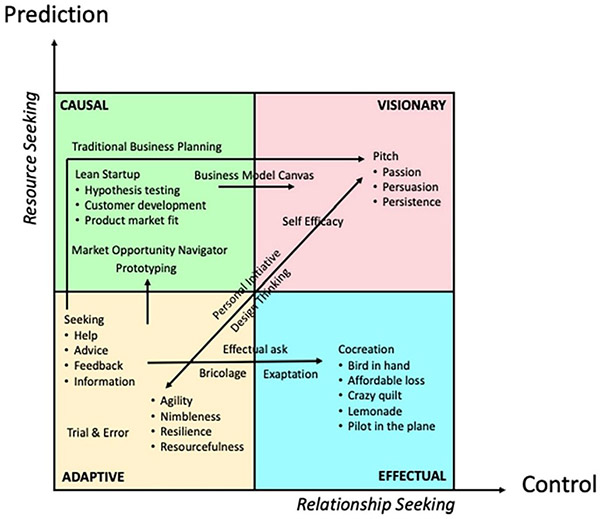
In real life, entrepreneurs move from quadrant to quadrant, using different tools in different situations. They also mix and match strategies from all quadrants as needed.
The CAVE framework is valuable for educators because it maps the various tools and techniques commonly found in entrepreneurship programs, such as the lean startup, the business model canvas and effectuation. It also provides guidance on how to effectively use those tools. As Professor Sarasvathy noted, “It’s one thing to teach students an ad hoc set of popular tools. It’s another to organize those tools into a rigorous framework.”
Professor Sarasvathy’s 2024 paper “Lean Hypotheses and Effectual Commitments: An Integrative Framework Delineating the Methods of Science and Entrepreneurship,” featuring the CAVE framework, can be accessed here.
-
New to Effectuation?
New to Effectuation?
Watch Professor Sarasvathy's "An Introduction to Effectuation" video, where she explores three types of uncertainty.
Check out the 29 April 2024 episode of the Hidden Brain podcast, “Innovation 2.0: How Big Ideas Are Born, in which Professor Sarasvathy discusses the logic of entrepreneurial expertise that eschews prediction in favor of non-predictive control with Hidden Brain’s host Shankar Vedantam.

-
Past Events
Reimagining Entrepreneurship Education
3 October 2025, Charlottesville, VATeaching through Teaching: Focus on Case Studies and Exercises on Effectual Partnering
9:30 - 10 a.m. Breakfast (outside Classroom 130)
While not shown in the agenda, there will be short breaks between sessions.
10 - 11:30 a.m. Live Demo: Deriving the CAVE Framework in Class (Classroom 130)
One way to teach is to present theories and frameworks through readings, then use them to analyze cases and apply them through exercises or projects. Another way to teach is to use a case study to derive the framework in the first place. The latter allows students to reach the “Aha!” moment more easily, after which teaching the principles and process of effectuation becomes highly engaging. In this session, Professor Saras Sarasvathy will present a live demo of a case study she uses to derive the CAVE (Causal, Adaptive, Visionary, Effectual) framework. She will also show how this opens the door to a deeper dive into the principles, process, and tricky nuances of the effectual ask and co-creational partnering.11:30 a.m. - 1 p.m. Applying the CAVE Framework to Effectual Partnering (Classroom 130)
One of the most important aspects of entrepreneurship in general, and effectual entrepreneurship in particular, is forming partnerships with various stakeholders, including customers, suppliers, distributors, key employees, investors, and others. Current teaching tends to overemphasize idea generation and customer discovery while neglecting the importance of securing early commitments from self-selecting stakeholders. This session will cover the fundamentals of effectuation, with a focus on the value of partnering. Again, the presentation will include a live case study.1 - 2:30 p.m. Lunch (the Abbott Dining Center)
Inventory of existing teaching materials including experiential exercises.2:30 - 4 p.m. Hands On Workshop: The Effectual Ask, Part 1 (the i.Lab)
In the spirit of teaching through teaching, the first half of the workshop will include a breakout team assignment that will allow you to be your students and explore teaching them. That means you can bring the assignment directly into your classroom with or without modifications.4 - 5:30 p.m. Hands On Workshop: The Effectual Ask, Part 2 (the i.Lab)
In the second half, we will build on the breakout team exercise to expand it into a class-wide exercise that connects it with partnering. This will also enable you to form pedagogical partnerships with other participants so that you can continue co-creating new teaching materials. The session will end with a quick debrief of the day and action items for the future.5:30 - 8 p.m. Reception & Dinner (the Abbott Dining Center)
Professor Sarasvathy’s 2024 paper “Lean Hypotheses and Effectual Commitments: An Integrative Framework Delineating the Methods of Science and Entrepreneurship,” featuring the CAVE framework, can be accessed here.2025 Attendees
Gaye Acikdilli
Associate Professor, Department of Management, Marketing & Public Administration, Bowie State UniversityCraig Armstrong
Associate Professor of Management, University of AlabamaPunit Arora
Associate Professor, the City College of New YorkRick Blume
Marketing Executive-in-Residence, Catawba CollegeSean Branagan
Director, Center for Digital Media and Entrepreneurship, Syracuse UniversityTomeka Carroll
University of VirginiaJose Cerecedo Lopez
Assistant Professor of Management & Entrepreneurship, Elon UniversityAruna Chandra
Chair & Professor, Scott College of Business, Indiana State UniversityQifan Chen
Assistant Professor of Management, Longwood UniversitySian Christie
Entrepreneur in Residence; Chair of Business and Economics; Director of Business and Management Studies, St. Olaf CollegeLarry Clay
Assistant Professor, Marymount UniversityKirsten Detrick
Adjunct Professor of Business Administration, Tuck School of Business, Dartmouth CollegeJames Dovel
Assistant Professor of Management, Shepherd UniversityKaren Eagle Lyster
Senior Lecturer, Old Dominion UniversityLulu Huang
Assistant Professor, the College of Business, University of Mary WashingtonChannelle James
Lecturer, UNC GreensboroLonell Johnson
Entrepreneurship Center Innovation Specialist, Bowie State UniversityElena Kennedy
Associate Professor of Entrepreneurship, Elon UniversityKevin Ketels
Associate Professor, Director, Entrepreneurship and Innovation Programs, Wayne State UniversityIndu Khurana
Associate Professor of Economics and Business, Hampden-Sydney CollegeJacqueline Kirtley
Assistant Professor of Management, Wharton School at the University of PennsylvaniaMichaela Krim
Ph.D. Candidate, Darden School of Business, University of VirginiaNorm Lyster
Adjunct Professor, Old Dominion UniversityChristine Mahoney
Professor of Public Policy and Politics, Frank Batten School of Leadership and Public Policy, University of VirginiaIleana Maldonado Bautista
Assistant Professor, Ivy College of Business, Iowa State UniversityErik Markin
Associate Professor of Management, Mississippi State UniversityPrem Menghwar
Postdoctoral Research Associate, UVA DardenMuhammad Muhammad
Assistant Professor of Practice, Texas Tech UniversityBala Mulloth
Associate Professor of Management, Catawba CollegeAynur Nabiyeva
Assistant Professor, University of St. ThomasJeremiah Nelson
Assistant Professor of Management, Catawba CollegeMaelle Perez
Ph.D. Candidate, Darden School of Business, University of VirginiaJudy Rady
Assistant Professor, the University of Kansas School of BusinessTiago Ratinho
Associate Professor, IESEG School of Management, FranceSharon Salvador
Ph.D. Candidate, Marymount UniversityPaul Sanchez-Ruiz
Assistant Professor, Ivy College of Business, Iowa State UniversityJanakan Saravanapavan
DBA candidate, Marymount UniversityKatrin Smolka
Associate Professor Entrepreneurship & Innovation, University of Warwick, United KingdomRafe Steinhauer
Associate Professor, Engineering, Dartmouth CollegeEthne Swartz
Professor of Information Management & Entrepreneurship, Montclair State UniversityJoanna Trammell
Associate Professor of Business, Catawba CollegeChristina Tupper
Associate Professor, North Carolina Technical and Agricultural College
Craig Watters
Clinical Associate Professor, School of Entrepreneurship, Oklahoma State UniversityMeg Weber
Assistant Professor, North Carolina Agricultural and Technical State UniversityMelanie White
Industry Partner & Board Member, Fairmont State UniversityChris Willis
Assistant Professor, University of Mary Washington
From the Plunge Decision to Soaring: Teaching Effectual Entrepreneurship through Case Studies and Experiential Exercises
9:30 a.m. - 10 a.m. Breakfast (outside Classroom 170)
10 a.m. - 11:30 a.m. The Plunge Decision: The CreditSource Case (Classroom 170)
Students—even when genuinely excited about becoming entrepreneurs—often stall when it comes to taking the plunge into starting a new venture. Entrepreneurship programs that focus only on idea generation and pitch competitions miss the opportunity to address what it takes to move from idea to action in building actual ventures. The CreditSource case tells the true story of Doug Lebda, a Darden student inspired by an entrepreneurship course to start his own business, CreditSource USA. It takes a realistic approach to the plunge decision, helping educators address a variety of issues that keep students dithering at the edge of the cliff. The key is helping students realize that the cliff is an illusion and that they can move forward by doing what is immediately doable.
11:45 a.m. - 1 p.m. Exercises in Doing the Doable (the i.Lab)
We will explore experiential exercises aimed at generating new venture ideas and practicing the entrepreneurial ask.
1:15 p.m. - 2:15 p.m. Lunch (the Abbott Dining Center)
2:30 p.m. - 4 p.m. Soaring with the Pilot(s) in the Plane Principle: The Lumni Case (Classroom 170)
What would it take to co-create a world where education is not treated as a necessity or a social service alone, but as a shared investment—one that generates meaningful returns for everyone involved? Imagine a system where we don’t just hold equity in companies but in the future potential of individuals across the economy. How would you even start such an ambitious transformation? The case Felipe Vergara and Lumni: Launching an Innovation in a Developing Economy chronicles the development of an international start-up offering innovative mechanisms for financing higher education. It demonstrates how to make the Pilot(s) in the Plane Principle come alive in a practical way.
4:15 p.m. - 5:30 p.m. Hands On Workshop: Stitching Your Crazy Quilt (the i.Lab)
This interactive session is designed to foster collaboration grounded in the day’s learnings and participants’ prior experience incorporating effectuation into their curricula to improve student outcomes. Participants will reflect on key insights, build on the day’s activities, and contribute to a growing community of effectuation educators. They should come prepared to share their needs, exchange ideas, and support one another in achieving their teaching objectives.
6:00 p.m - 8 p.m. Reception & Dinner (Oak Boardroom, the Forum Hotel)
IMPORTANT:
This year, we will offer an Introduction to Effectuation webinar one to two weeks prior to the in-person event at the Darden School of Business. The webinar will be open to all attendees; however, those new to effectuation are strongly encouraged to participate to build a foundational understanding of its principles and maximize the value of the sessions with Professor Sarasvathy.
This is an invitation-only event exclusively for college and university educators. For more information, please contact Gosia Glinska at glinskam@darden.virginia.edu.
This is an invitation-only event exclusively for college and university educators. For more information, please contact Gosia Glinska at glinskam@darden.virginia.edu.
Business schools teach that prediction is critical in strategic decision-making based on the assumption that what can be predicted can be controlled. Entrepreneurs, however, learn from experience that prediction is not the only lever for formulating strategy. In a startup environment, where little is predictable, it may be useful to separate prediction from control. This gives entrepreneurs more options as they can access not one, but two levers.
Having studied expert entrepreneurs, Professor Saras Sarasvathy developed a framework with prediction and control as its axes. The framework’s quadrants represent four strategic approaches expert entrepreneurs use to navigate uncertainty inherent in venture creation.
Causal: Relies on prediction and planning
Adaptive: Focuses on pivoting and adapting to the environment
Visionary: Seeks to compel the world to follow
Effectual: Emphasizes shaping and co-creating elements of the environment in partnerships with self-selecting stakeholders
In real life, entrepreneurs move from quadrant to quadrant, using different tools in different situations. They also mix and match strategies from all quadrants as needed.
The CAVE framework is valuable for educators because it maps the various tools and techniques commonly found in entrepreneurship programs, such as the lean startup, the business model canvas and effectuation. It also provides guidance on how to effectively use those tools. As Professor Sarasvathy noted, “It’s one thing to teach students an ad hoc set of popular tools. It’s another to organize those tools into a rigorous framework.”
Professor Sarasvathy’s 2024 paper “Lean Hypotheses and Effectual Commitments: An Integrative Framework Delineating the Methods of Science and Entrepreneurship,” featuring the CAVE framework, can be accessed here.
New to Effectuation?
Watch Professor Sarasvathy's "An Introduction to Effectuation" video, where she explores three types of uncertainty.
Check out the 29 April 2024 episode of the Hidden Brain podcast, “Innovation 2.0: How Big Ideas Are Born, in which Professor Sarasvathy discusses the logic of entrepreneurial expertise that eschews prediction in favor of non-predictive control with Hidden Brain’s host Shankar Vedantam.
Reimagining Entrepreneurship Education
3 October 2025, Charlottesville, VA
Teaching through Teaching: Focus on Case Studies and Exercises on Effectual Partnering
9:30 - 10 a.m. Breakfast (outside Classroom 130)
While not shown in the agenda, there will be short breaks between sessions.
10 - 11:30 a.m. Live Demo: Deriving the CAVE Framework in Class (Classroom 130)
One way to teach is to present theories and frameworks through readings, then use them to analyze cases and apply them through exercises or projects. Another way to teach is to use a case study to derive the framework in the first place. The latter allows students to reach the “Aha!” moment more easily, after which teaching the principles and process of effectuation becomes highly engaging. In this session, Professor Saras Sarasvathy will present a live demo of a case study she uses to derive the CAVE (Causal, Adaptive, Visionary, Effectual) framework. She will also show how this opens the door to a deeper dive into the principles, process, and tricky nuances of the effectual ask and co-creational partnering.
11:30 a.m. - 1 p.m. Applying the CAVE Framework to Effectual Partnering (Classroom 130)
One of the most important aspects of entrepreneurship in general, and effectual entrepreneurship in particular, is forming partnerships with various stakeholders, including customers, suppliers, distributors, key employees, investors, and others. Current teaching tends to overemphasize idea generation and customer discovery while neglecting the importance of securing early commitments from self-selecting stakeholders. This session will cover the fundamentals of effectuation, with a focus on the value of partnering. Again, the presentation will include a live case study.
1 - 2:30 p.m. Lunch (the Abbott Dining Center)
Inventory of existing teaching materials including experiential exercises.
2:30 - 4 p.m. Hands On Workshop: The Effectual Ask, Part 1 (the i.Lab)
In the spirit of teaching through teaching, the first half of the workshop will include a breakout team assignment that will allow you to be your students and explore teaching them. That means you can bring the assignment directly into your classroom with or without modifications.
4 - 5:30 p.m. Hands On Workshop: The Effectual Ask, Part 2 (the i.Lab)
In the second half, we will build on the breakout team exercise to expand it into a class-wide exercise that connects it with partnering. This will also enable you to form pedagogical partnerships with other participants so that you can continue co-creating new teaching materials. The session will end with a quick debrief of the day and action items for the future.
5:30 - 8 p.m. Reception & Dinner (the Abbott Dining Center)
Professor Sarasvathy’s 2024 paper “Lean Hypotheses and Effectual Commitments: An Integrative Framework Delineating the Methods of Science and Entrepreneurship,” featuring the CAVE framework, can be accessed here.
2025 Attendees
Gaye Acikdilli
Associate Professor, Department of Management, Marketing & Public Administration, Bowie State University
Craig Armstrong
Associate Professor of Management, University of Alabama
Punit Arora
Associate Professor, the City College of New York
Rick Blume
Marketing Executive-in-Residence, Catawba College
Sean Branagan
Director, Center for Digital Media and Entrepreneurship, Syracuse University
Tomeka Carroll
University of Virginia
Jose Cerecedo Lopez
Assistant Professor of Management & Entrepreneurship, Elon University
Aruna Chandra
Chair & Professor, Scott College of Business, Indiana State University
Qifan Chen
Assistant Professor of Management, Longwood University
Sian Christie
Entrepreneur in Residence; Chair of Business and Economics; Director of Business and Management Studies, St. Olaf College
Larry Clay
Assistant Professor, Marymount University
Kirsten Detrick
Adjunct Professor of Business Administration, Tuck School of Business, Dartmouth College
James Dovel
Assistant Professor of Management, Shepherd University
Karen Eagle Lyster
Senior Lecturer, Old Dominion University
Lulu Huang
Assistant Professor, the College of Business, University of Mary Washington
Channelle James
Lecturer, UNC Greensboro
Lonell Johnson
Entrepreneurship Center Innovation Specialist, Bowie State University
Elena Kennedy
Associate Professor of Entrepreneurship, Elon University
Kevin Ketels
Associate Professor, Director, Entrepreneurship and Innovation Programs, Wayne State University
Indu Khurana
Associate Professor of Economics and Business, Hampden-Sydney College
Jacqueline Kirtley
Assistant Professor of Management, Wharton School at the University of Pennsylvania
Michaela Krim
Ph.D. Candidate, Darden School of Business, University of Virginia
Norm Lyster
Adjunct Professor, Old Dominion University
Christine Mahoney
Professor of Public Policy and Politics, Frank Batten School of Leadership and Public Policy, University of Virginia
Ileana Maldonado Bautista
Assistant Professor, Ivy College of Business, Iowa State University
Erik Markin
Associate Professor of Management, Mississippi State University
Prem Menghwar
Postdoctoral Research Associate, UVA Darden
Muhammad Muhammad
Assistant Professor of Practice, Texas Tech University
Bala Mulloth
Associate Professor of Management, Catawba College
Aynur Nabiyeva
Assistant Professor, University of St. Thomas
Jeremiah Nelson
Assistant Professor of Management, Catawba College
Maelle Perez
Ph.D. Candidate, Darden School of Business, University of Virginia
Judy Rady
Assistant Professor, the University of Kansas School of Business
Tiago Ratinho
Associate Professor, IESEG School of Management, France
Sharon Salvador
Ph.D. Candidate, Marymount University
Paul Sanchez-Ruiz
Assistant Professor, Ivy College of Business, Iowa State University
Janakan Saravanapavan
DBA candidate, Marymount University
Katrin Smolka
Associate Professor Entrepreneurship & Innovation, University of Warwick, United Kingdom
Rafe Steinhauer
Associate Professor, Engineering, Dartmouth College
Ethne Swartz
Professor of Information Management & Entrepreneurship, Montclair State University
Joanna Trammell
Associate Professor of Business, Catawba College
Christina Tupper
Associate Professor, North Carolina Technical and Agricultural College
Craig Watters
Clinical Associate Professor, School of Entrepreneurship, Oklahoma State University
Meg Weber
Assistant Professor, North Carolina Agricultural and Technical State University
Melanie White
Industry Partner & Board Member, Fairmont State University
Chris Willis
Assistant Professor, University of Mary Washington